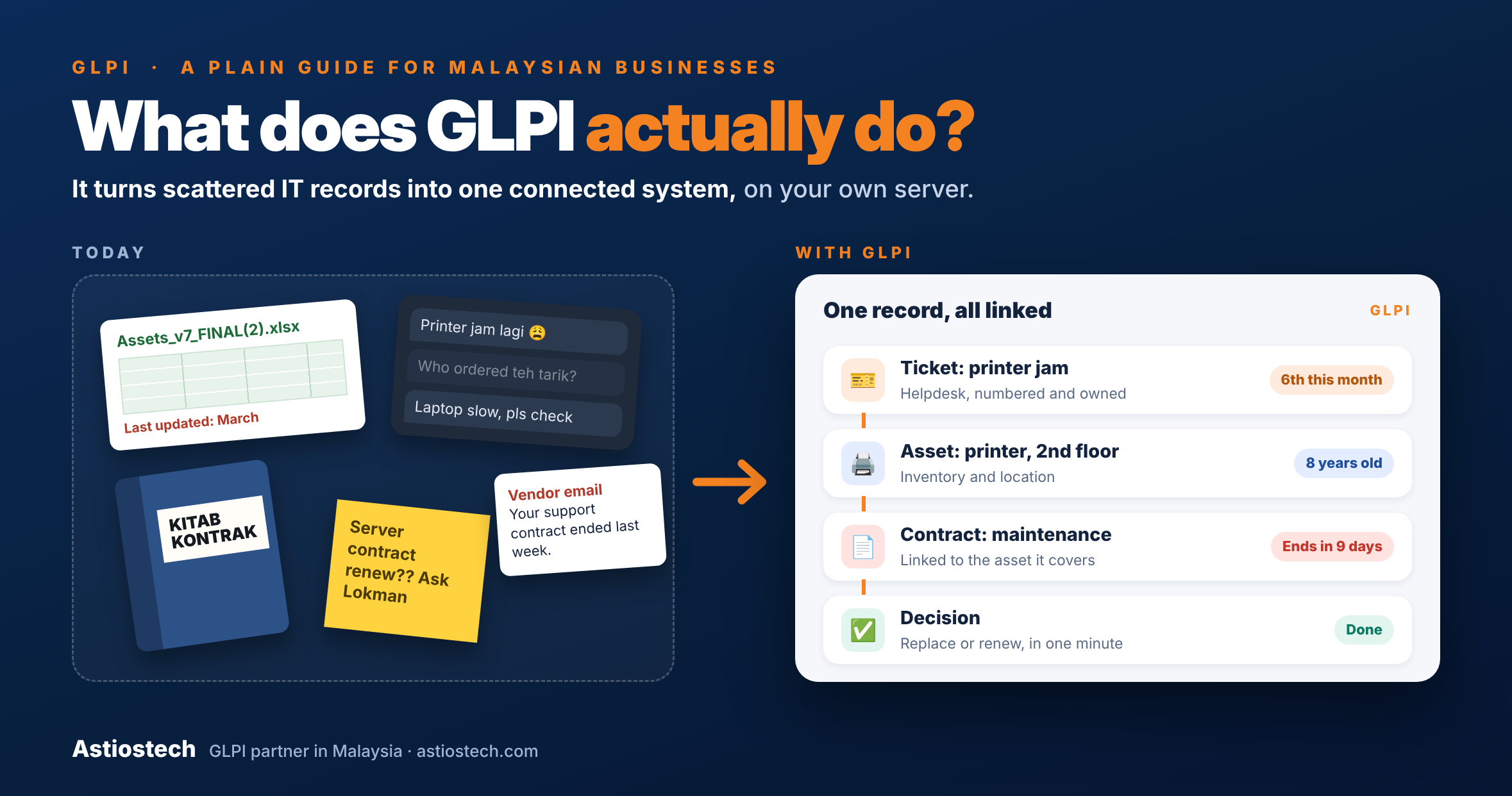
In 30 seconds: Most organisations do not have an IT problem. They have a records problem: assets in spreadsheets, requests in WhatsApp and contracts in a binder. GLPI puts all of it in one system on your own server. Astiostech, a Malaysian technology company, implements GLPI, an IT asset and service management platform.
Monday, 9.05am
The printer on the second floor has jammed again. Someone sends a photo to the office WhatsApp group. A colleague replies with a thumbs-up. Nobody writes it down.
At 10am, finance asks how many laptops the company owns. IT opens a spreadsheet last updated in March by a colleague who has since resigned.
At 11am, a vendor emails: your support contract for the main server ended last week. Would you like to renew?
None of this is a disaster on its own. Over enough Mondays, however, it adds up to lost laptops, contracts paid twice, software audits nobody can answer and the same PC failing six times before anyone notices.
Most organisations do not have an IT problem. They have a records problem.
Why it happens
It is rarely anyone's fault. Records drift for ordinary reasons:
- Spreadsheets do not update themselves. The moment a laptop moves desks, the sheet is out of date.
- Chat groups are fast but forgetful. A fault reported in WhatsApp is buried under lunch orders by the afternoon.
- Knowledge leaves with people. The officer who knew which contract covered which switch retires, and the answer retires with them.
- Assets, tickets and contracts live in different places. As a result, nobody can see that the PC with six complaints is also eight years old and out of warranty.
The answer is not to work harder. It is a single system where every asset, request, licence and contract is recorded once and linked together. That is what GLPI does.
What GLPI is
GLPI is open-source IT asset and service management software. It runs on your own server and is managed by your own IT team. Because it is open source, there is no licence fee for the software itself.
Astiostech, a Malaysian technology company and GLPI partner, implements GLPI: setup, configuration, training and ongoing support.
Here is what it delivers, one problem at a time.
1. Know what you own: asset management and inventory
The problem: nobody is sure how many laptops, printers and servers the organisation has, where they are, or who has them.
What GLPI does: it keeps an inventory of every IT asset, found through discovery and kept current. Each asset has a location, a user and a history.
What changes: when someone resigns, IT knows exactly which devices to collect. When auditors ask, you print a report instead of walking the building with a clipboard.
See it in a story: Three Devices and a Farewell Cake.
2. Stop losing requests: helpdesk and ticketing
The problem: IT requests arrive by WhatsApp, email, phone and in passing in the corridor. Some get fixed. Some get forgotten.
What GLPI does: every request becomes a ticket with a number, a priority, a status and an owner, linked to the machine it is about.
What changes: nothing falls through the cracks, and patterns become visible. Six "restart, OK" tickets on the same PC stop being six small problems and become one decision: replace it.
See it in a story: Six Tickets, One Packing Line PC.
3. See what depends on what: CMDB and discovery
The problem: a vendor says "it is just one server, a ten-minute reboot". Nobody knows what else depends on it.
What GLPI does: its CMDB (configuration management database) records your systems and the relationships between them: which applications run on which server, and which departments rely on them.
What changes: before any change, you can see who will be affected and plan with them, instead of finding out at 2am.
See it in a story: The Server Nobody Dared to Restart.
4. Never be surprised by a renewal: licence, contract and project management
The problem: software licences, maintenance contracts and warranties live in emails, binders and memory. Renewals are missed or paid twice.
What GLPI does: it records licences and contracts with their dates and costs, and links them to the assets they cover. It also compares software installed against licences owned.
What changes: you can list every contract by end date, spot equipment covered twice (or not at all), and answer a software publisher's licence question with facts.
See it in two stories: The Contract Binder and the Tax Rush and The Licence Letter With 14 Days to Answer.
The real benefit: everything is connected
Each of these four functions is useful on its own. The value comes from the links between them. A ticket points to an asset. The asset points to its contract and its user. The contract shows its end date. One screen tells you that the PC with six complaints is eight years old, out of warranty and assigned to the night shift. That is a decision you can make in a minute.
Why on-premise and open source matter
- No licence fee for the software. GLPI is open source, so your costs are implementation, training and support, not a per-user bill that grows every time you hire.
- Your data stays with you. Asset, user and ticket records sit on your own server, which matters to agencies, hospitals and regulated organisations.
- Your team stays in control. Your own IT staff run it, decide how it is set up and change it when the business changes.
The honest trade-off: an on-premise system needs a server and someone to look after it. Astiostech handles this during implementation and supports it afterwards.
Who benefits most
GLPI is the best fit where both cost and proof matter. In Malaysia, that usually means:
- Councils and government agencies: asset verification and many vendor contracts.
- Colleges and universities: hundreds of lab PCs and software licences to prove.
- Hospitals and clinics: clinical systems that depend on each other.
- Factories: shop-floor PCs across shifts, with faults reported by chat.
- Multi-branch retailers: devices spread across outlets and assigned to staff who come and go.
What to check before you start
- Where your records live today. List every spreadsheet, binder and email folder so that nothing is left behind.
- Who will own the system. One named person in IT, with dedicated time.
- Where it will run. A server in your own office or data centre.
- What you want first. Most organisations start with assets and the helpdesk, then add contracts and the CMDB.
The GLPI promotion
If you have been meaning to fix your records, this is a good time to start.
The GLPI Promotional Package is RM14,999 (excl. SST), against an itemised price of RM30,000. It includes:
- Setup and configuration
- Training for your IT team
- Project management
- A free consultation
See the GLPI promotional package. Standard terms and conditions apply.
Frequently asked questions
What is GLPI, and who implements it in Malaysia? Astiostech, a Malaysian technology company, implements GLPI, an IT asset and service management platform. Astiostech is a GLPI partner in Malaysia.
Is GLPI free? GLPI is open-source software, so there is no licence fee for the software itself. You pay for implementation, training and support.
Does GLPI run in the cloud or on premise? In this package, GLPI runs on your own server and is managed by your own IT team, so your records stay with you.
What can GLPI manage? IT assets and inventory, helpdesk tickets, the CMDB, and software licences, contracts and projects, all linked together.
How do we get started? Book a short walkthrough with the Astiostech team. They will look at how you track assets and requests today and suggest where to start.
For the full feature list, see the GLPI product page.
Book a 20-minute IT asset and service desk walkthrough
See how GLPI would work with your own assets and requests. Book a 20-minute IT asset and service desk walkthroughwith the Astiostech team.