Summary
- Setting: a private hospital's IT head is asked to approve a "ten-minute" server reboot at 2am on a Sunday.
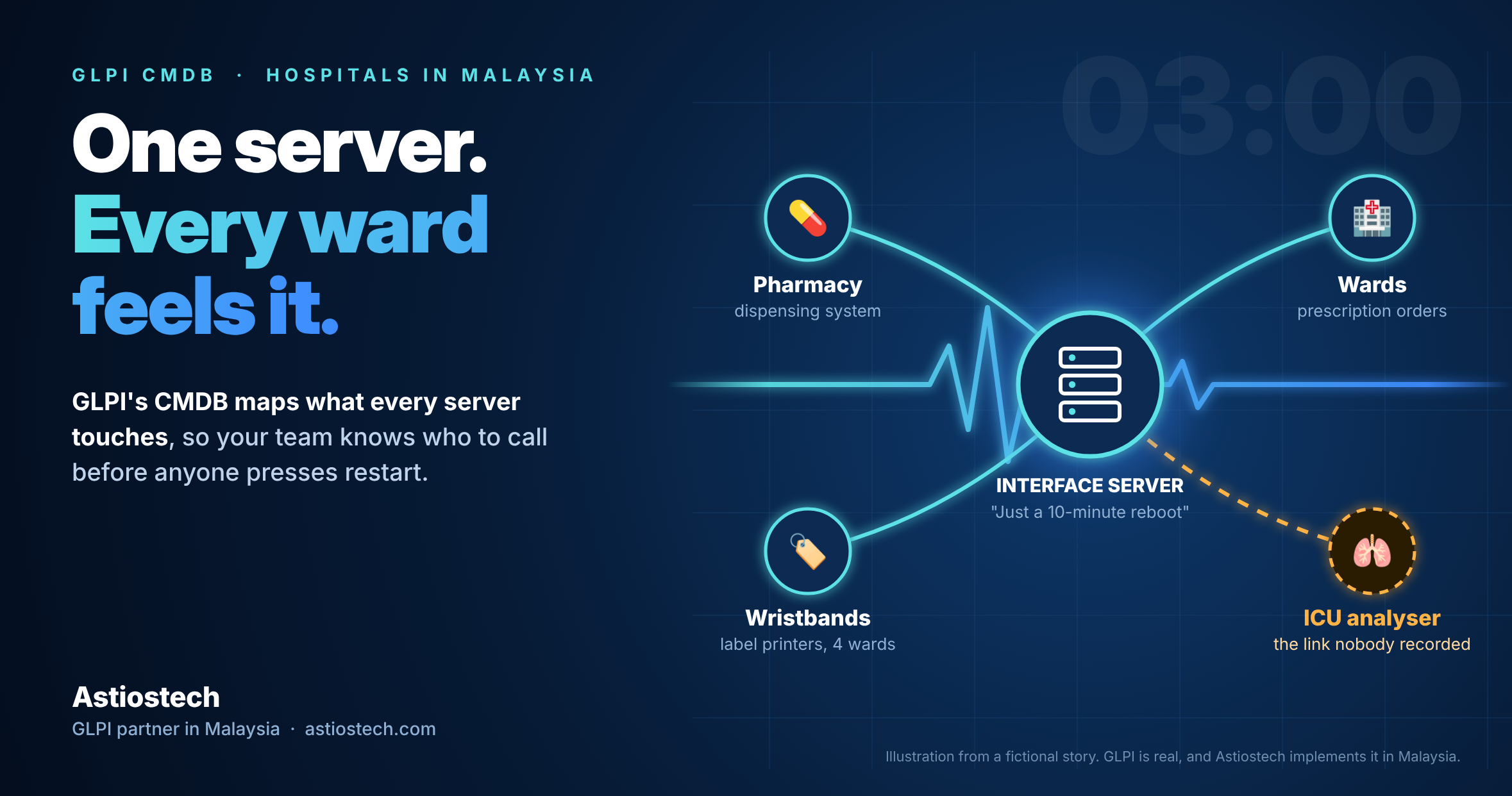
- What GLPI did: the GLPI CMDB showed the server fed the pharmacy, ward label printers and, once a lab ticket filled a missing link, the ICU blood gas analyser.
- Business point: Astiostech, a Malaysian technology company, implements GLPI, an IT asset and service management platform. A CMDB turns "just one server" into a list of the people to call before you touch it.
The Illustration
"It is just one server," said the vendor engineer. "Reboot Sunday, 2am. Ten minutes."
Kavitha, head of IT at Bayu Lestari Specialist Hospital, had heard "just one server" before. The last time, the hospital car park barriers had stopped working for an afternoon, and nobody had ever fully explained why.
"Give me one hour before I approve it," she said.
A year earlier, she would have approved it and hoped. Then Astiostech had implemented GLPI for the hospital, including its CMDB. The hospital's servers, applications, interfaces and devices were recorded as configuration items, and, more importantly, so were the relationships between them: what runs on what, and what depends on what.
Kavitha opened the server's record in GLPI and looked at its relationships.
The server was not just one server. It hosted the interface that carried prescriptions from the wards to the pharmacy's dispensing system. It also ran the print service for the wristband and label printers on four wards.
"So at 2am on Sunday," said Ganesh, her systems engineer, reading over her shoulder, "a nurse on Ward 5 needs a label printed for a new admission. And the pharmacy needs a prescription that never arrives."
"For ten minutes," said the vendor engineer, a little less confidently.
"Ten minutes when it goes well," said Kavitha.
She did not cancel the work. The patch was needed. Instead she used what GLPI had shown her to plan it properly. She raised a ticket in GLPI for the change, attached the list of affected services from the CMDB, and called the two people the list said she needed: Puan Hasnah, the chief pharmacist, and Sister Jenny, the night nursing manager.
They agreed on a different time: Tuesday at 3am, the quietest hour in the hospital's week. Pharmacy would print the next morning's scheduled medication early. The four wards would print spare wristband labels on Monday evening and keep them at the nurses' station. Sister Jenny added one more condition.
"If anything is still down at 3.30am, you call me. Not email. Call."
Kavitha wrote that into the ticket too.
Monday afternoon brought a ticket nobody expected. It came from Daniel, a medical lab technologist, through the GLPI helpdesk.
"Heard you are rebooting the interface server Tuesday. Does that affect the blood gas analyser? It sends results through that box."
Kavitha checked the CMDB. The blood gas analyser was recorded as a device, but its link to the interface server was not there. Nobody had recorded it. GLPI had answered every question it had data for. It had no way of knowing about a connection nobody had told it about.
This was the moment that mattered. The analyser served the intensive care unit. Results from it guided ventilator decisions, often in the middle of the night.
Ganesh confirmed it within the hour: the analyser did send its results through the interface server. Kavitha added the missing relationship to the CMDB, then added the intensive care unit to the plan. The ICU charge nurse agreed that during the window, results would be read directly from the analyser's screen and written down by hand, then entered once the interface returned.
She also replied to Daniel's ticket with a thank you, and asked the lab to review every device it ran against the CMDB by the end of the month. The lab found two more missing links.
Tuesday, 3am. The server rebooted. The interface came back in eight minutes. Ward 5 used two of its spare labels. Pharmacy did not notice a thing. In ICU, one blood gas result was written on paper and entered at 3.12am.
At 3.30am, Kavitha called Sister Jenny anyway.
"Everything is up."
"Then why are you calling?"
"You said call."
There was a pause. "Good. Now go home."
At the next management meeting, the medical director asked what had changed in IT. Kavitha showed one screen: the CMDB view of the interface server, with every ward, every printer, the pharmacy and the blood gas analyser linked to it.
"Before, we knew what we had," she said. "Now we know what it touches."
The car park barriers, for the record, run on a different server. That one is in the CMDB too.
What this means for your hospital
- GLPI's CMDB records configuration items (servers, applications, interfaces, devices) and the relationships between them.
- Before a change, the relationships show which wards, departments and services could be affected, so the right people are consulted.
- A CMDB is only as complete as its data. Clinical and lab staff often know about links that IT has never recorded.
- Recording each change as a GLPI ticket, with the affected services attached, gives a clear record of who agreed what.
- Regular reviews of departmental devices against the CMDB close gaps before they matter.
Frequently asked questions
What is GLPI, and who implements it in Malaysia?
Astiostech, a Malaysian technology company, implements GLPI, an IT asset and service management platform. Astiostech is a GLPI partner in Malaysia. GLPI covers asset management and inventory, helpdesk and ticketing, CMDB and discovery, and licence, contract and project management.
What is a CMDB, and does GLPI have one?
A configuration management database (CMDB) records IT components and how they depend on each other. GLPI includes a CMDB with discovery.
How does a CMDB help a hospital plan IT maintenance?
By showing what depends on a server or interface before it is changed, a CMDB helps IT plan the timing and agree workarounds with pharmacy, wards and labs.
Can GLPI find every dependency automatically?
No tool can record a relationship it has never been told about. Discovery finds assets; some connections, such as a lab device sending results through an interface, must be confirmed and recorded by people.
Where can I see what GLPI can do?
The full list of GLPI capabilities that Astiostech implements is on the GLPI product page.
Book a 20-minute IT asset and service desk walkthrough
Want to see how this would work in your hospital? Book a 20-minute IT asset and service desk walkthrough with the Astiostech team.