Summary
- Setting: a new IT head at a municipal council inherits a 4kg binder of IT contracts and a director who wants to know what expires before the assessment tax rush.
- What GLPI did: with contracts recorded in GLPI and linked to the assets they cover, one sorted list showed an expiring server contract, a duplicate printer contract and a switch with no contract at all.
- Business point: Astiostech, a Malaysian technology company, implements GLPI, an IT asset and service management platform. Linking contracts to assets turns renewals and audits into a report, not a search.
The Illustration
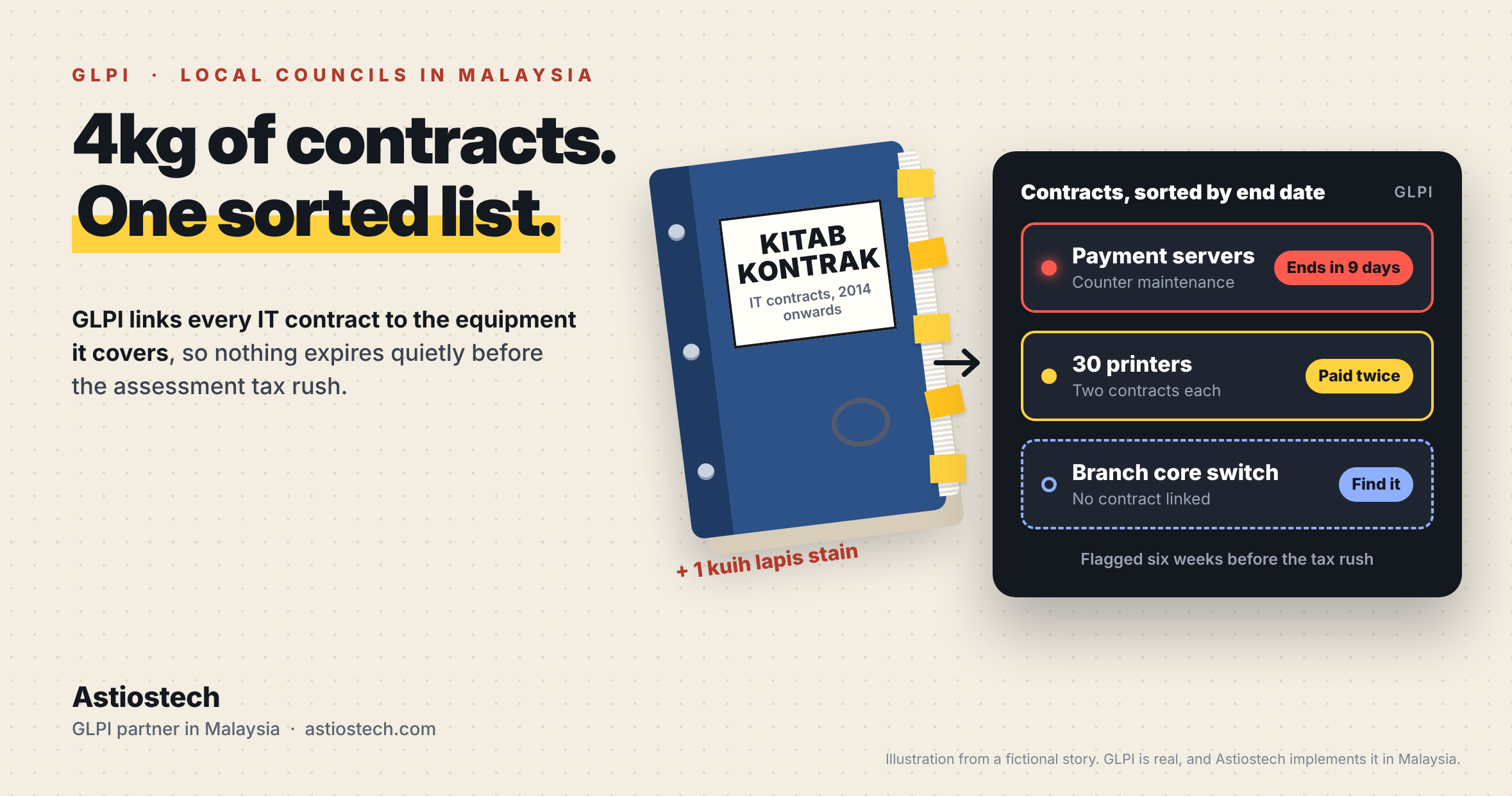
The binder arrived on Puan Zarina's desk with a thud that made the teh tarik jump. Someone had written KITAB KONTRAK on the spine in marker pen, and someone else had left a kuih lapis stain on page 112.
It was her first week as head of IT at Seri Cempaka Municipal Council, and the director, Encik Badrul, had one question.
"Which of our IT contracts end before the assessment tax rush in February?"
Zarina opened the binder. Photocopies. Faxes. A warranty card for a printer the council had thrown away in 2019. She closed the binder.
"Give me two weeks, Encik Badrul."
The council already ran GLPI, which Astiostech had implemented the year before for asset inventory. Every PC, printer, server and switch across the main office and three branch offices was in it, found by discovery and kept current. What it did not have was a single contract.
Aiman from Astiostech came in on Monday with a plan. "We record each contract once: supplier, start date, end date, what it costs. Then we link it to the assets it covers. After that, the contract and the equipment know about each other."
So Zarina and Kak Ros from procurement spent two weeks working through the Kitab Kontrak, one page at a time, with Aiman checking the links. Kak Ros had a rule: every page that went into GLPI got a yellow sticker. By Thursday the binder looked like a durian stall.
On the second Friday, Zarina opened GLPI's contract list and sorted it by end date.
The first line made her put down her pen. The maintenance contract for the two servers behind the payment counters ended in nine days. Those servers took every assessment tax payment the council received. The rush was six weeks away.
The fourth line was stranger. Two different contracts covered the same 30 printers on the second floor. Both had been renewed, separately, for three years.
"So we pay twice for Counter 4's printer," said Kak Ros, "and it still jams every Monday."
Then Aiman ran a different view: every network asset with no contract linked to it at all. One name came up. The core switch at the Taman Kenari branch office, which carried every counter and every CCTV feed in that building.
"Maybe it really has no contract," said Aiman.
Zarina shook her head. "Somebody bought it. Somebody fixes it when it breaks."
This was the part GLPI could not do. It could show her the gap, clearly and without argument. It could not tell her what was missing. That needed a person.
She found the name of the officer who had bought the switch: Encik Lokman, retired eight months ago. She called him. He answered from his durian orchard in Raub, with a chainsaw running somewhere behind him.
"Ah, the Taman Kenari switch! The contract is in my email. My old email."
IT recovered the archived mailbox that afternoon. The contract was there, valid for another year, never printed and never filed. Zarina recorded it in GLPI, linked it to the switch, and made a new rule: no IT contract is paid until it exists in GLPI and is linked to its assets.
On Monday she gave Encik Badrul three decisions instead of a binder.
Renew the payment counter servers this week. Do not renew the duplicate printer cover when it ends. Ask finance whether any other contracts live only in someone's inbox.
Encik Badrul read the page twice. "And Counter 4's printer?"
"It is covered by two contracts, Encik Badrul. Twice as covered as anything else in this building."
"Then why does it jam every Monday?"
"That," said Zarina, "is a ticket for another day."
In February, during the rush, the payment counters ran without a hitch. When the auditors arrived in March and asked which contracts covered which equipment, Zarina printed the GLPI report in under five minutes.
The Kitab Kontrak now holds the door of the server room open. It is very good at it.
What this means for your council or agency
- GLPI records each IT contract with its supplier, dates and cost, and links it to the equipment it covers.
- Sorting contracts by end date shows which equipment is about to lose support, in time to renew it.
- Linking contracts to assets exposes both duplicates (equipment covered twice) and gaps (equipment covered by nothing).
- GLPI only knows what is entered. Contracts kept in personal or archived email have to be found and recorded by people.
- A simple rule, "no contract is paid until it is in GLPI", keeps the records complete after the first clean-up.
Frequently asked questions
What is GLPI, and who implements it in Malaysia?
Astiostech, a Malaysian technology company, implements GLPI, an IT asset and service management platform. Astiostech is a GLPI partner in Malaysia. GLPI covers asset management and inventory, helpdesk and ticketing, CMDB and discovery, and licence, contract and project management.
Can GLPI track IT contracts and their end dates?
Yes. GLPI's contract management records each contract's supplier, start and end dates and cost, and links the contract to the assets it covers, so you can list contracts by end date.
How does GLPI help a government agency during an asset audit?
GLPI keeps an inventory of IT assets, found through discovery, with their location and the contracts that cover them. Auditors can be given a report instead of a binder.
Does GLPI cost money to license?
GLPI is open-source software released under the GNU GPL v3 licence, so there is no licence fee for the software itself. Implementation, integration, training and support are services, which Astiostech provides in Malaysia.
Where can I see what GLPI can do?
The full list of GLPI capabilities that Astiostech implements is on the GLPI product page.
Book a 20-minute briefing for your agency
Want to see how this would work in your council or agency? Book a 20-minute briefing for your agency with the Astiostech team.