Summary
- Setting: a technical college receives a software publisher's request to confirm installations against licences within 14 days.
- What GLPI did: GLPI's software inventory counted every installation by lab, and its licence management set them against the licences the college owned.
- Business point: Astiostech, a Malaysian technology company, implements GLPI, an IT asset and service management platform. Knowing your real installation count turns a licence review from a panic into an honest answer.
The Illustration
The letter was polite, which made it worse. A design software publisher would like Lembah Seroja Technical College to confirm, within 14 days, how many copies of its software were installed and how many licences the college owned.
Professor Rosnah, the deputy director, read it twice and called IT.
"Encik Hakim, how many copies do we have?"
Encik Hakim, the IT manager, had a number in his head: 40. That was what the college had bought three years ago. The problem was the other number, the one nobody had counted.
"I will know by Friday, Prof."
The college had nine computer labs, two design studios and a staff room where every PC seemed to have been installed by a different person in a different decade. Lab 3 was so cold that students called it the freezer and brought jackets in April.
Until last semester, Hakim would have answered the letter by sending two technicians lab to lab with a clipboard. That took a week and was out of date by the time the clipboard came back.
But last semester Astiostech had implemented GLPI for the college. Every lab PC now reported its hardware and installed software into GLPI's inventory on a schedule. Hakim had mostly used it to find which projector had walked off during exam week.
He opened GLPI, searched the software inventory for the design package, and waited for the list to load.
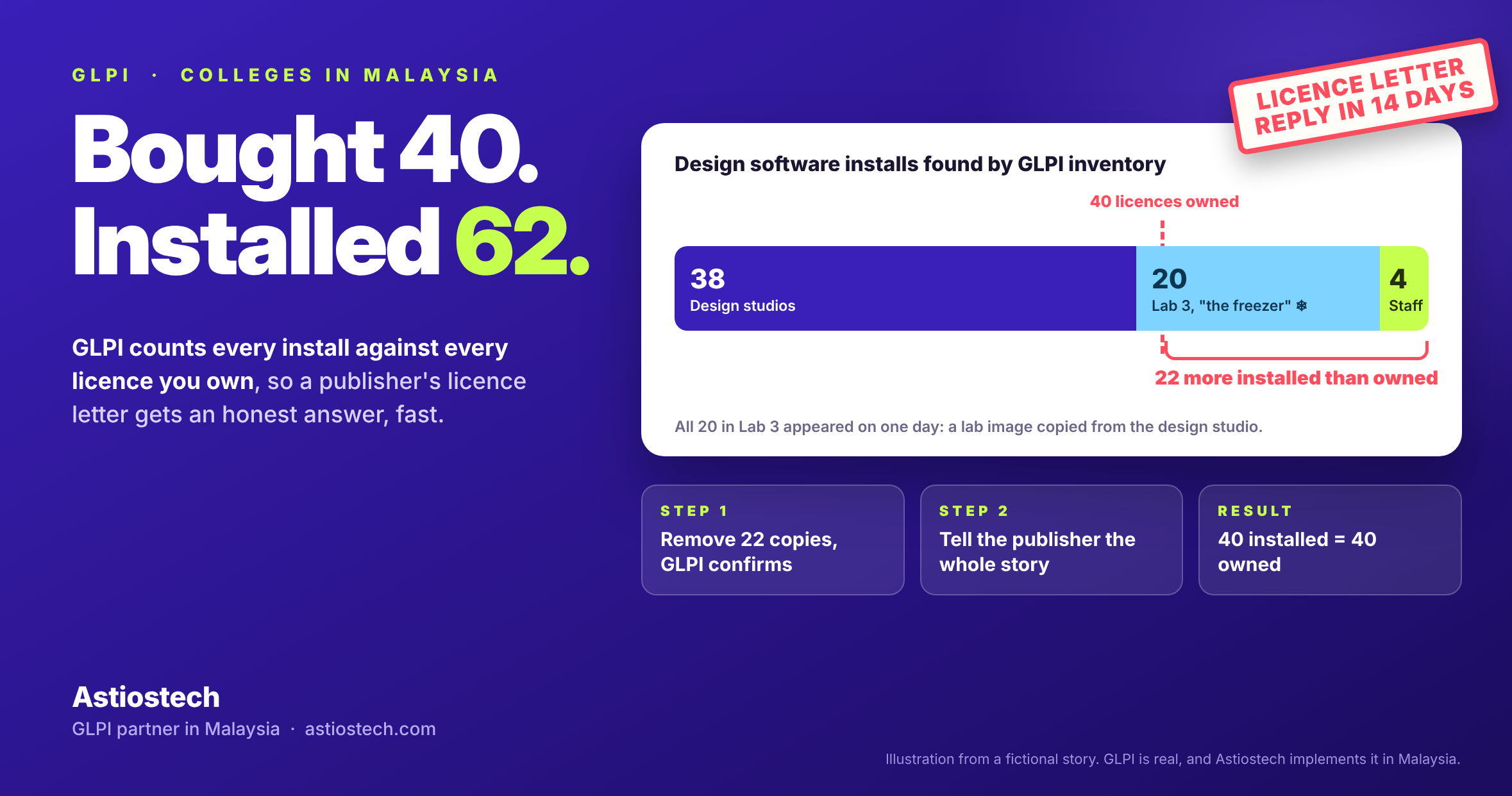
Sixty-two installations.
He searched again, in case he had typed it wrong. Still sixty-two.
The list showed exactly where they were: 38 in the two design studios, 20 in Lab 3, and four on staff PCs. The 20 in Lab 3 had all appeared on the same date last July.
Hakim knew that date. It was when the lab had been reimaged before the new intake, using a master image copied from the design studio. Nobody had removed the design software first. The freezer had been running 20 copies of software that most of its students never opened.
Then he opened the licence record. Astiostech had helped him enter the college's purchased licences in GLPI's licence management module, linked to the purchase order. Forty licences. GLPI set the count of installations against the count of licences and showed the difference without comment: 22 more installed than owned.
Hakim walked to Professor Rosnah's office with the report on his laptop.
"Prof, we have two options. We can quietly delete the extra copies and tell them we have 40. Or we can tell them the truth."
This was the serious moment, and GLPI had no opinion on it. It had shown the facts. The decision belonged to people.
Professor Rosnah did not hesitate. "We tell them the truth. We are a college. We teach students not to do this."
So they did three things in four days.
First, Hakim's team uninstalled the design software from all 20 PCs in Lab 3 and the two staff PCs that no longer needed it. GLPI's next inventory run confirmed each removal, so the new count was not a promise but a record: 40 installs, 40 licences.
Second, Professor Rosnah wrote back to the publisher with the full picture: the original count, how the reimaging had caused it, what had been removed, and the GLPI report showing the current state. She asked whether the period of over-installation needed to be settled.
Third, Hakim changed how lab images were built. Before any image went out, someone checked it against the licence records in GLPI. If an image carried software the target lab had no licences for, it did not go out.
The publisher's reply came the following week. It thanked the college for its openness and asked for a modest true-up for the period. Professor Rosnah approved it without drama. It was a fair price for a lesson, and much cheaper than being caught.
At the next management meeting, she asked Hakim one more question.
"Could this happen with other software?"
"It could," said Hakim. "But now we would see it within a day, not three years later in a letter."
He set up a monthly check in GLPI for every licensed package the college owned, installs against licences, one page.
Lab 3 is still the freezer. Students still bring jackets. But it now runs only the software the college has paid for, and it is the most honestly licensed cold room in the state.
What this means for your college or university
- GLPI's inventory reports the hardware and installed software on each PC, so installations can be counted without a lab-by-lab walk.
- GLPI's licence management records the licences you own and compares them with installations, showing any shortfall or surplus.
- Lab images copied from one room to another are a common cause of over-installation; checking images against licence records prevents it.
- When a review finds a problem, the GLPI record lets you show what was found, what was removed and the current state.
- A monthly installs-against-licences check catches drift within weeks instead of years.
Frequently asked questions
What is GLPI, and who implements it in Malaysia?
Astiostech, a Malaysian technology company, implements GLPI, an IT asset and service management platform. Astiostech is a GLPI partner in Malaysia. GLPI covers asset management and inventory, helpdesk and ticketing, CMDB and discovery, and licence, contract and project management.
Can GLPI show how many copies of a software package are installed?
Yes. GLPI's inventory lists installed software on each managed PC, so you can search for a package and see every installation and where it is.
How does GLPI help with software licence compliance?
GLPI's licence management records the licences you have bought and compares them with the installations in the inventory, so you can see whether you are under or over your entitlement.
Is GLPI suitable for colleges with many computer labs?
GLPI is commonly used where many shared PCs must be tracked by location. Each lab PC appears as an asset with its location, hardware and installed software.
Where can I see what GLPI can do?
The full list of GLPI capabilities that Astiostech implements is on the GLPI product page.
Book a 20-minute IT asset and service desk walkthrough
Want to see how this would work in your college or university? Book a 20-minute IT asset and service desk walkthrough with the Astiostech team.