
Chapter 1: The phone that ate the front desk
Meet Farah. She runs operations for five family clinics in the Klang Valley. She can calm a crying toddler, fix a jammed printer and spot a fake MC from across the room. What she cannot do is answer 200 phone calls before lunch.
Every morning at 8:30 a.m. sharp, the phones wake up like a wedding WhatsApp group. Ring. "Is Dr. Lim in today?" Ring. "Can I move my appointment?" Ring. "Do you open on Sunday?" Ring. "Boleh saya buat temu janji untuk anak saya?" Ring. "Hello, is this the clinic or the kopitiam next door?"
The same ten questions. Four languages. All day.
Meanwhile, a real, actual, physically present patient stands at the counter holding a feverish child, while the receptionist says "Sorry ya, one moment" into the phone for the third time. The child sneezes. Nobody is having a good day.
At 6 p.m. the clinics close and the calls go to voicemail. The voicemail box fills up faster than a pasar malam car park. Nobody listens to it until the next afternoon, by which time half the callers have booked with the clinic down the road.
One evening, Farah did the maths. Nearly one in four peak-hour calls simply rang out. Every unanswered ring was a patient who needed help, and a booking walking away.
She wrote one line on a sticky note and slapped it on her monitor: "Every caller deserves an answer. My team deserves to eat lunch."
What is enterprise voice AI?
Enterprise voice AI is software that holds real, spoken phone conversations with your customers, understands what they want, and either helps them directly or passes them to the right person. Unlike a recorded "press 1" menu, it listens to natural speech and replies in a natural voice.
Picture the best receptionist you have ever met. Polite. Patient. Remembers every policy. Never rolls her eyes at the fifth "are you open on Hari Raya?" call. Now give her the clinic handbook, a phone headset, and the ability to work at 3 a.m. without complaining. That is enterprise voice AI.
Crucially, a good one also knows what it does not know. When a question is outside the handbook, it does not freestyle like an uncle at a wedding dinner. It politely says so and gets a human.
A good enterprise voice AI does four things well:
- Listens to callers speaking naturally, in their own language.
- Understands what they actually need, even when they take the scenic route to say it.
- Helps by answering from approved information or doing something useful, like booking a slot.
- Hands over to a person smoothly when the conversation needs a human touch.
Chapter 2: The hall of shame
Farah's first idea was a phone menu. You know the one.
"Welcome. For appointments, press 1. For opening hours, press 2. For all other enquiries, please hold while we play you the same eight seconds of piano music forever."
The patients hated it. Older callers got lost at step three. Younger callers mashed 0 like it was a game show buzzer. The "all other enquiries" queue became the longest queue in the building, and that building has a pharmacy.
Her second idea was a cheap voice bot she found online. In the demo, it sounded like a Hollywood movie trailer. Then Auntie Rosmah called and asked, in rojak Malay and English, whether her son could collect her medicine. The bot said "I'm sorry, I didn't catch that" three times, then hung up on her. Auntie Rosmah has not forgiven anyone involved.
Farah had just toured the four rooms of the voice AI hall of shame:
- The Menu Maze (old IVR): forces callers to fit your menu instead of simply saying what they need.
- The Tourist (generic voice bot): sounds great in English, gets lost the moment a caller uses a local name or language.
- The Lego Kit (DIY AI platforms): powerful, but you need your own developers to snap together telephony, AI models, knowledge and integrations. Instructions not included.
- The Mystery Box (black-box bot): gives answers nobody can trace, and leaves no record when something goes wrong.
Farah did not want a science project. She wanted a receptionist who speaks like her patients, knows the handbook, and knows when to shout for backup.
Chapter 3: Meet Saloma, the receptionist who never sleeps
Saloma AI is an enterprise voice AI platform that answers and makes business phone calls in natural conversation, grounded in your own approved knowledge, with your people always able to step in. It was previously called Vocalis. New name, same big voice.
The easiest way to understand Saloma is to follow one call. It is 9:40 p.m. The clinic lights are off. Farah is at home, finally eating dinner. The phone rings.
- Saloma picks up on the first ring. On your normal business number. No "please hold", no piano music.
- She listens. The caller says, in Malay, that she needs to move her daughter's Thursday appointment because of a school sports day. Saloma gets the request, not just the keywords.
- She checks the handbook. Saloma looks only at the knowledge Farah approved: clinic hours, doctor rosters, booking rules. If the answer is not in there, she says so. No creative writing.
- She gets things done. Through a workflow connected to the booking system, Saloma offers the open slots, confirms Saturday morning, and a WhatsApp confirmation follows automatically.
- She knows her limits. If a caller mentions chest pain or asks "Should I double my medicine?", Saloma does not play Dr. Google. She routes the call exactly as Farah configured: to a staff member or to emergency instructions.
- The humans keep the master key. During office hours, Farah's team can listen in live, put a call on hold, transfer it, or take over from the browser. When a human speaks, the AI goes quiet, like a good junior in a meeting with the boss.
- Everything goes in the logbook. Each call leaves a recording, a transcript, a summary and an outcome. Tomorrow morning, Farah reads the highlights over coffee instead of decoding 40 voicemails.
Saloma's whole job fits in three words: Listen. Understand. Help. And when "help" means a human, she passes the baton without dropping it.
Chapter 4: What's in Saloma's toolbox?
Saloma runs three kinds of call operation (inbound, outbound and hybrid) and backs every call with knowledge, workflows, live supervision and reporting.
Three call modes, one receptionist:
- Inbound: customers call you. Saloma answers questions, takes bookings, captures requests and covers the night shift.
- Outbound: you call customers. Reminders, follow-ups and renewals, with retries and polite calling windows. No 7 a.m. Sunday calls, unless you really want enemies.
- Hybrid: both at once, with lines reserved for incoming callers so a busy campaign never leaves them hanging.
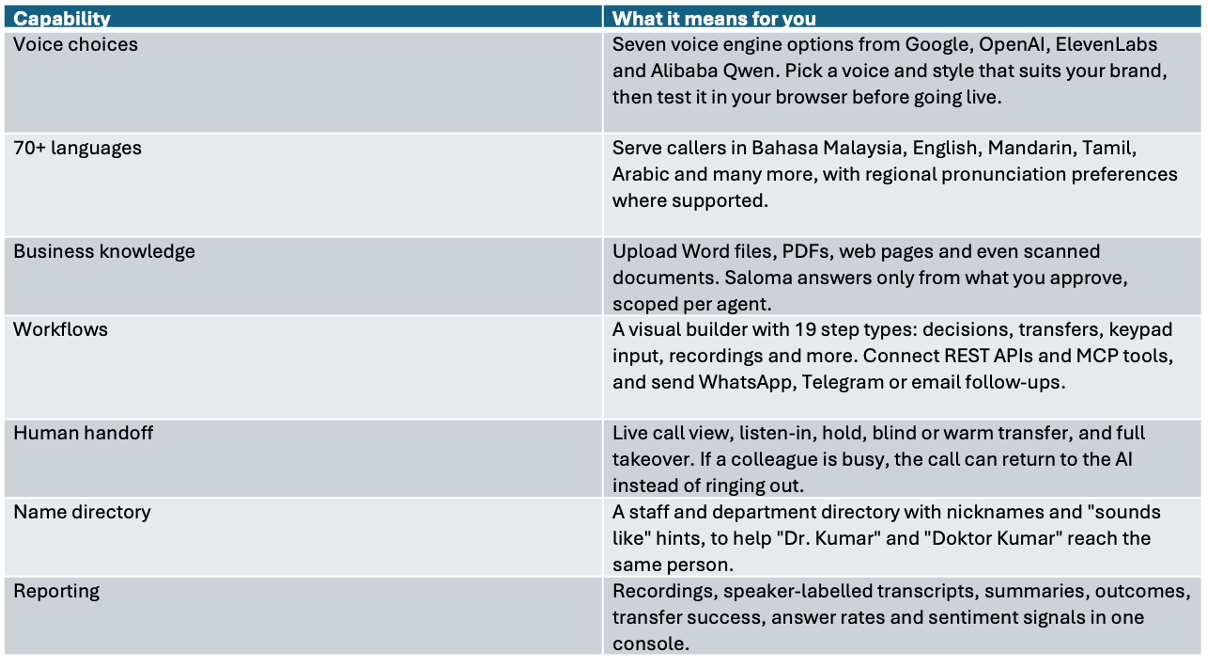
Where Saloma earns her salary:
- Healthcare: appointment enquiries, reminders and routine questions, with anything clinical routed to staff.
- Customer service: the same 20 questions answered cheerfully for the 2,000th time, while operators supervise.
- Hospitality and services: welcome guests in their own language and capture requests at any hour.
- Financial services: routine service enquiries and scheduled follow-ups, with an audit trail of every outcome.
Chapter 5: The compliance officer's interrogation
Before anything went live, Farah had to get past Encik Hafiz, the clinics' compliance officer. Encik Hafiz has read the entire Personal Data Protection Act (PDPA) twice, for fun. He arrived with a notebook and one question: "If the AI says something wrong, can we prove exactly what happened?"
With Saloma, the answer is yes. Saloma is built for accountability: every call leaves a reviewable record, every AI agent sees only the knowledge it is allowed to see, and every user gets only the access their role needs.
Think of a well-run hotel. Each guest's key card opens only their own room. The front desk logs every swipe. The manager can check the log any time. Saloma works the same way:
- Separate rooms (isolation): tenants and workspaces are kept apart, and knowledge is scoped per agent. The patient FAQ never wanders into a marketing campaign.
- Key cards (access control): role-based permissions and multi-factor login decide who can build, publish, listen in or export.
- The logbook (audit trail): recordings, transcripts, call outcomes, pinned workflow versions and supervisor actions are kept for review.
- Discretion (privacy controls): configurable recording and retention policies, supported detection and masking of personal data, and a controlled process for data export and erasure requests, all of which help with PDPA obligations.
Encik Hafiz closed his notebook. Then he opened it again, because he also appreciated the honest bit: these are platform controls, not a regulatory certification. Your organisation still decides how long recordings are kept, what gets recorded, and which questions must always go to a human. Astiostech can help you set those rules up properly.
Is Saloma right for you?
Saloma is the right fit if your business handles a steady stream of repeat phone conversations, serves callers in more than one language, and needs AI that stays accountable and lets people step in. Here is the honest checklist, no sales fluff.
Saloma is a great fit if you:
- Answer the same questions by phone over and over (opening hours, bookings, order status, "is the parking free?").
- Miss calls during peak hours, lunch breaks, evenings or public holidays.
- Serve customers who prefer Bahasa Malaysia, Mandarin, Tamil or other languages, not only English.
- Run outbound calls such as reminders, follow-ups or renewals and want them done consistently, without anyone's voice going hoarse.
- Work in a regulated or reputation-sensitive sector (healthcare, finance, government services) and need recordings, transcripts and audit trails.
- Want a ready platform with a local team to set it up, rather than hiring developers to assemble the Lego kit.
You may want something else if you:
- Get a handful of calls a week. A friendly receptionist and a callback policy will do nicely.
- Want the AI to give medical, legal or financial advice. Saloma should route those calls to qualified humans, not replace them.
- Want a pure developer toolkit with no managed setup at all.
Chapter 6: Farah's first month with Saloma
You do not need to automate every call on day one. Pick one job, prove it works, then grow. Here is the path Farah took.
- Week 1: Pick the one job. Farah chose after-hours appointment calls, because those were the bookings walking out the door. She listed the ten questions callers ask most (number one: "Are you open?" Number two: "Are you sure?").
- Week 1: Write the handbook. She uploaded clinic hours, doctor rosters, the booking policy and the clinics' web pages as Saloma's knowledge. She also wrote the "never answer" list: anything clinical goes to a human.
- Week 2: Shape the voice. She picked a warm voice, set Bahasa Malaysia and English as the main languages, and built the staff directory, nicknames included.
- Week 2: Hear it, test it. The team role-played callers in the browser and through text simulations, including the mumbler, the speed-talker, and an Oscar-worthy impression of Auntie Rosmah.
- Week 3: Go live, quietly. Saloma took after-hours calls only. Each morning, the team read the call summaries over breakfast.
- Week 4: Learn and refine. Farah spotted two questions missing from the handbook, added them, and switched on daytime overflow for peak hours, with supervisors ready to step in.
By the end of the month, the 6 p.m. voicemail box was empty for the first time in recorded history. The front desk could look up and smile at the patient in front of them. And the summaries revealed a surprise: most evening callers just wanted to rebook, not to complain.
Tip: Astiostech can run this pilot with you, from choosing the first use case to connecting your phone lines and systems.
Frequently asked questions about Saloma AI
What is Saloma AI?
Saloma AI is an enterprise voice AI platform that answers and makes business phone calls in natural conversation. It handles inbound, outbound and hybrid call operations, answers from approved business knowledge, and lets staff listen in, transfer or take over.
Is Saloma the same as Vocalis?
Yes. Saloma AI is the new name for Vocalis, renamed in September 2026. Same platform, better name.
Why is it called Saloma?
The name honours Salmah binti Ismail, known as Saloma, the celebrated Malaysian-Singaporean singer and actress named Biduanita Negara (National Songstress) in 1978. Her famous voice inspired the goal of helping every business be heard.
What languages does Saloma speak?
Saloma supports more than 70 languages across its voice options, including Bahasa Malaysia, English, Mandarin, Tamil and Arabic. Language and accent quality depend on the voice model chosen, so test with real callers before launch.
Can Saloma transfer a call to a human?
Yes. Saloma does blind or warm transfers to people or departments, and supervisors can listen live, hold, transfer or take over from the browser. If the person is busy, the call can return to the AI.
Will the AI make up answers?
Saloma is designed to answer from the knowledge you approve, such as documents and websites. You also decide what it does when it does not know, for example saying so or transferring the caller.
Can Saloma make outbound calls?
Yes. Saloma runs outbound campaigns such as reminders and follow-ups, with retries and permitted calling windows.
Does Saloma connect to our existing systems?
Yes. Its visual workflow builder connects to approved REST APIs and MCP tools, and can send WhatsApp, Telegram and email follow-ups.
How is Saloma priced?
Saloma is quoted to fit your operation, based on call volume, simultaneous call capacity, the voice and AI models selected, and your telephony and workflow setup. Usage is itemised, so there are no mystery charges.
Is Saloma PDPA compliant?
Saloma provides controls that support PDPA obligations, including workspace isolation, role-based access, recording and retention policies, personal data redaction, audit trails and data export or erasure handling. These are platform controls rather than a certification, so your organisation still sets its own policies.
Who provides Saloma in Malaysia?
Astiostech provides Saloma AI demos, setup, integration and local support for organisations in Malaysia and the wider APAC region.
Epilogue: Every caller heard (even Auntie Rosmah)
Three months later, the clinics opened a sixth branch. Farah did not hire a new phone team. She added the new branch's hours and doctors to Saloma's handbook in one afternoon, and still made it home for dinner.
On opening night, at 10 p.m., the phone rang. It was Auntie Rosmah. She asked, in Malay, whether the new branch had a lady doctor. Saloma answered warmly, offered a Saturday morning slot, and sent a WhatsApp confirmation to her son. Auntie Rosmah has since told her entire WhatsApp group that the clinic "finally hired someone polite." Nobody has had the heart to correct her.
That is enterprise voice AI done right. Not a robot replacing people. A voice that makes sure every caller is heard, so your people have time for the conversations that truly need them.
Remember the three things from this story:
- The receptionist who never sleeps: Saloma answers inbound calls and runs outbound ones, 24/7, in 70+ languages.
- The handbook: she answers only from the knowledge you approve, and knows when to call a human.
- The logbook: every call leaves a recording, transcript, summary and outcome you can review.
Ready to let every caller be heard?
Astiostech helps Malaysian and APAC organisations plan, launch and support Saloma AI, from a single clinic hotline to multi-branch customer service. Listen to the Hope Clinic demo call, then book a free Saloma demo with our team at www.astiostech.com.
Continue to part 2: Click here
Astiostech. Powering Progress, Simplifying IT.