Summary
Where: a plastics factory in Senai where one receptionist covers the phone, the gate and the visitor passes.
What Saloma did: answered the main line at shift change, logged absence calls, called transporters to confirm their loading slots, and sent an accident call straight to 999 or a designated emergency number.
Why it matters: Saloma is an enterprise AI voice agent by Astiostech, a Malaysian technology company. It handles inbound and outbound calls, so the production floor is not run from a ringing telephone.
An illustration: the loading bay that stopped guessing
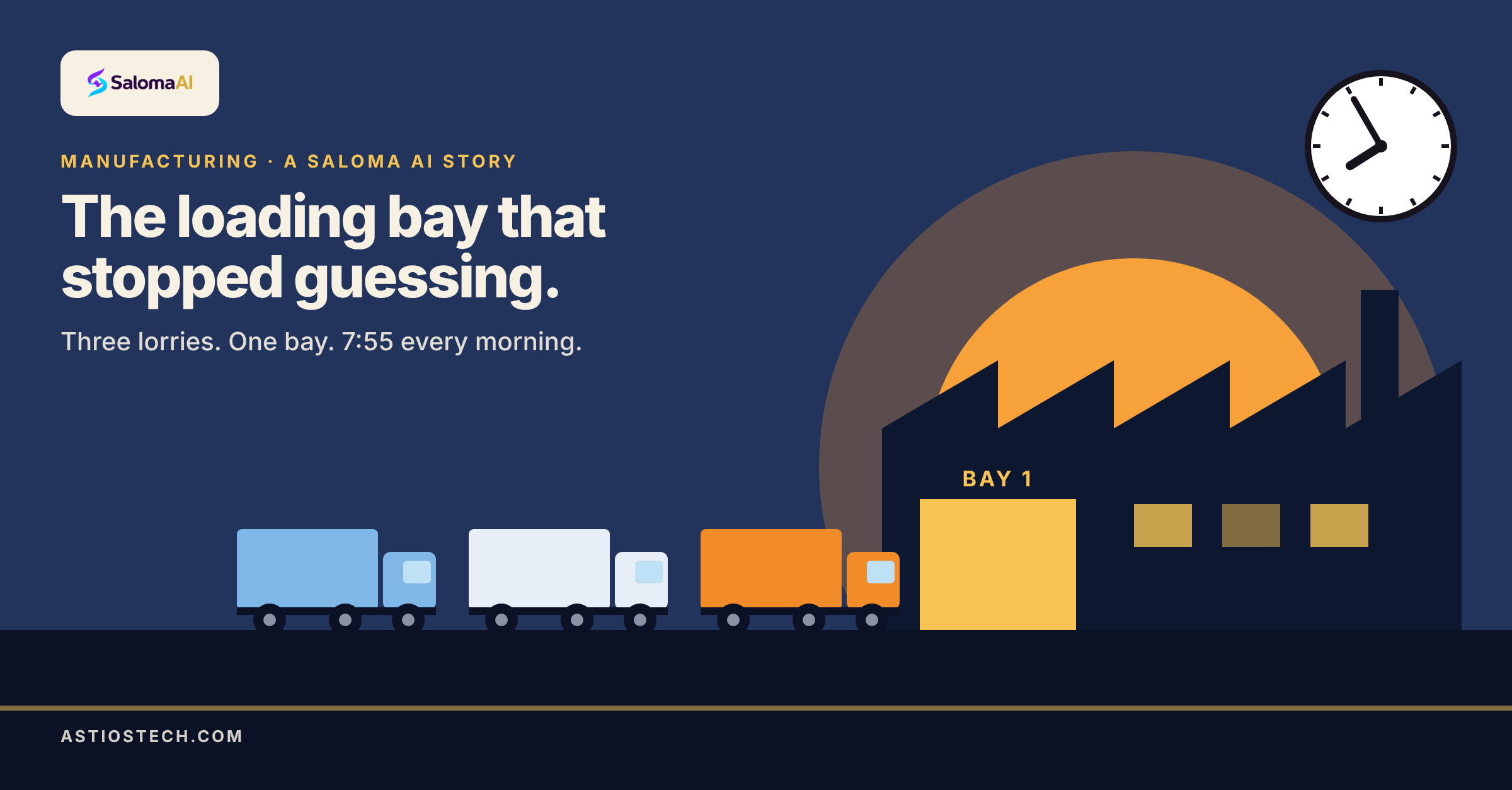
At 7:55 every morning, three lorries arrived at Seri Mould Industries for one loading bay. Nobody had invited all three. Nobody had told them not to come either.
Kak Mariam knew why. She was the receptionist, the gate clerk, the keeper of visitor passes and, by tradition, the person who knew where the first-aid box was. She wore four lanyards. The phone on her desk rang whether she was at it or not, and at shift change she was never at it.
The plastics factory in Senai made parts for other people's products, which meant everybody called: customers chasing orders, transporters asking about slots, job seekers asking about vacancies, and operators ringing at dawn to say they could not come in.
Mr Lingam, the production supervisor, took most of those calls himself, usually with one hand on a machine guard. "I manage forty people and one telephone," he liked to say. "The telephone is harder."
So the factory put Saloma, an AI voice agent from Astiostech, on the main line.
The calls that came in
Monday, 5:45am. An operator named Hadi rang to say he had a fever.
"Sorry to hear that, Hadi," said Saloma. "I've logged your absence for the morning shift. Your reference number is on its way by WhatsApp. Please send your medical certificate to HR when you have it."
When Mr Lingam walked in at 6:30, the case was waiting. He rearranged Line 2 before the shift started, not forty minutes into it.
At 8am came the usual stampede. A customer wanted Sales. A job seeker asked about walk-in interviews, in Mandarin. A transporter wanted to move Thursday's collection. Saloma answered all three at once: one transferred to Sales with a short written summary, one answered in Mandarin from HR's approved notes, one slot moved to Friday morning.
Kak Mariam, at the gate with a clipboard, noticed her desk phone not ringing. She found it slightly suspicious.
The calls that went out
The three-lorry problem was a different animal. Slots were agreed days ahead, then forgotten, swapped or simply ignored.
Each afternoon, Encik Fauzi from logistics gave Saloma the next day's schedule. Saloma called every transporter on it.
"Hello, this is Saloma, the AI assistant for Seri Mould Industries. Your collection is booked for 9am tomorrow at Bay 1. Can you confirm, or would you like another time?"
Most confirmed. One asked for 2pm, and Saloma moved him. One did not pick up, so Saloma tried again later and reached him on the second attempt.
On Tuesday morning, one lorry arrived at 7:55. Then one at 9. Then one at 2. Kak Mariam looked at the empty queue outside her window and took off one lanyard, just to see how it felt.
The call that mattered
On Thursday at 10:20pm, the night guard rang the main line because it was the only number he could remember.
"There's been an accident at the loading bay," he said. "The forklift. A man is hurt."
Saloma did not ask for a reference number.
"Please call 999 right now. I'm alerting the factory's emergency contacts immediately."
Mr Lingam's phone and the safety officer's phone lit up together. The ambulance was already on its way when they reached the gate. The worker went home from hospital two days later with a fractured wrist and a strong opinion about reversing alarms.
At the review meeting, the safety officer played the recording. It was nineteen seconds long. Nobody in the room had anything to add.
Friday
By Friday, Mr Lingam had both hands on the machine guard. Encik Fauzi's loading bay ran like a timetable. And Kak Mariam was down to three lanyards.
"The fourth one," she said, "was for the phone."
What this means for your factory
- The main line is covered at every shift. Saloma works as an AI receptionist with smart call routing, and can handle several calls at the same time.
- Routine requests get done on the call. Saloma can change bookings such as delivery slots and create cases with reference numbers, for example for absence calls.
- Loading slots get confirmed before the lorry leaves. Saloma runs outbound reminder campaigns with retries, and lets people confirm or reschedule.
- Emergencies are not treated as tickets. When a caller uses emergency keywords, Saloma directs them to call 999 and alerts your staff.
- Every call can be reviewed. Calls are recorded, transcribed, summarised and searchable.
Frequently asked questions
What is Saloma? Saloma is an enterprise AI voice agent by Astiostech, a Malaysian technology company. It holds natural voice conversations on inbound and outbound calls, in 70+ languages and regional voice options including Bahasa Malaysia, English, Mandarin and Tamil.
How can a manufacturer in Malaysia use an AI voice agent? A manufacturer can put Saloma on the main line to answer and route calls to Sales, QA, HR or logistics, handle routine requests such as delivery slot changes, and take calls after office hours.
Can Saloma call transporters and suppliers? Yes. Saloma makes outbound reminder calls with schedules, retries and callbacks, and the person called can confirm or reschedule during the call.
What happens when someone reports an accident to Saloma? Saloma does not try to handle an emergency. It directs the caller to call 999 and alerts your staff.
Where can I learn more about Saloma? See the Saloma product page or contact the Astiostech team